 Brian Fencing and Gates
Should Driveway Gates Open In or Out? What to Check First
How to tell whether your driveway gates should swing in, swing out or slide, and the measurements and questions that decide it.
The details
Practical considerations for your next gate or fence.
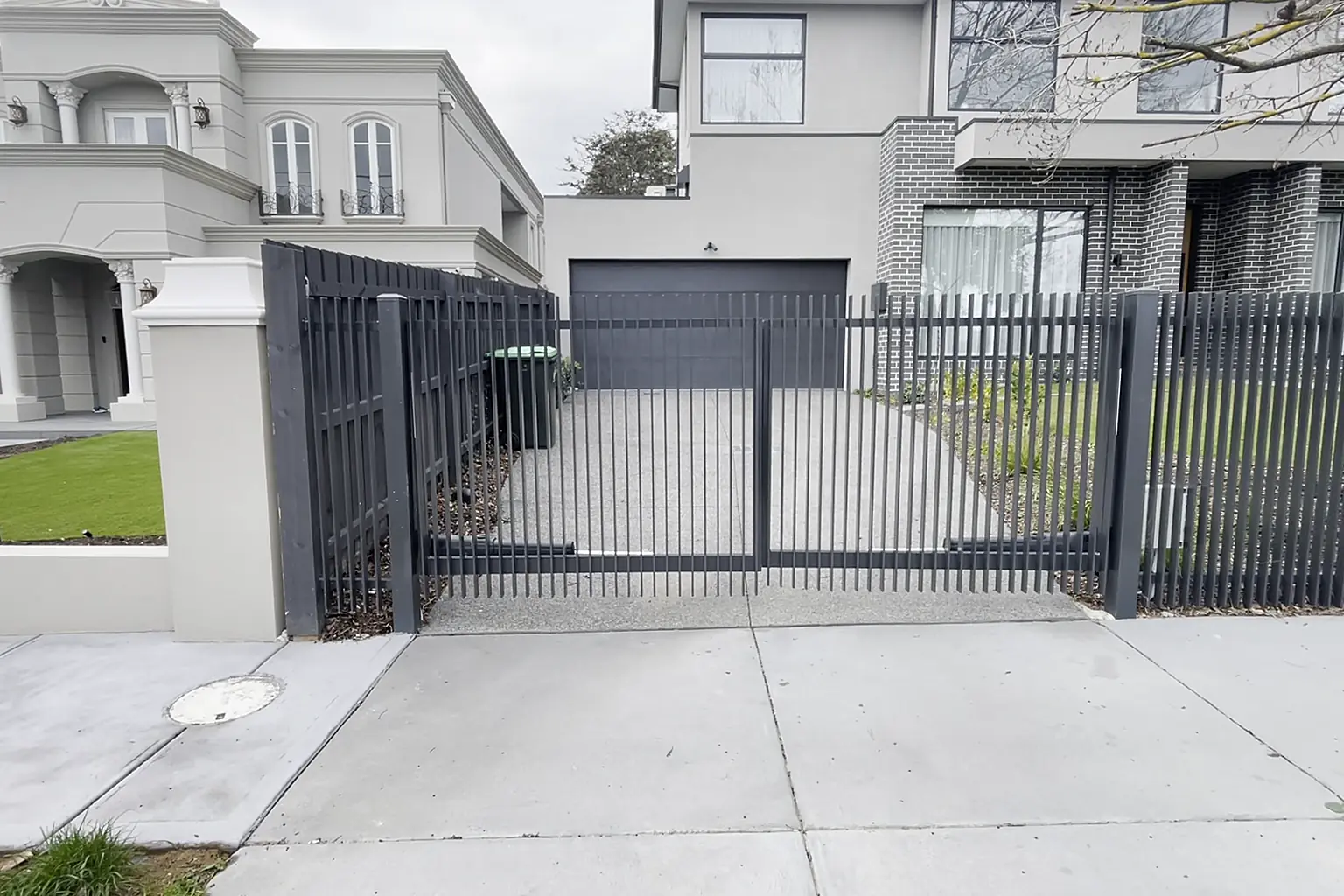
If you’re putting in a new driveway gate or replacing an old one, the direction it opens is one of the first decisions to make. Most people asking should driveway gates open in or out want to avoid a gate that scrapes the driveway, hits the car or swings across the footpath. For most Melbourne front yards the answer is inward, onto your own property. But the slope of the driveway, the space behind the gate line and your local council’s requirements decide what actually works.
Below are the measurements to take, the alternatives when an inward swing won’t fit, and the questions to ask before anything is built.
Why inward is the usual starting point
An inward swing is the default for practical reasons:
- The footpath stays clear. A gate that opens outward swings over land you don’t own, into the path of pedestrians, prams and mobility scooters. Many councils restrict gates that open over a footpath or road reserve, so check with your local council before planning a gate that does.
- Hardware sits on your side. With an inward swing, the hinges, drop bolts and any motor arms are inside the property, where they’re harder to tamper with.
- The gate is easier to secure. Leaves that close against a stop on your side of the piers resist being pushed open from the street.
Outward opening usually comes up when the driveway climbs steeply from the street, or when the garage or parked car sits too close to the boundary for an inward leaf to clear. Even then, reversing the swing is rarely the best answer. A different gate type often solves the problem more neatly.
Measurements to take before you decide
A tape measure and ten minutes will tell you most of what you need. Photograph each measurement as you take it:
- Opening width between the piers or posts, at both the top and the bottom. Piers aren’t always plumb, and a difference of a centimetre or two affects how a gate fits.
- Swing depth. A swing gate needs clear ground behind the fence line roughly equal to the width of each leaf. For a pair, each leaf is about half the opening, so a 4 metre opening needs about 2 metres clear behind each pier.
- Driveway fall. Run a string line or long straight edge from the gate line into the property across the arc each leaf will travel. If the driveway rises towards the house, an inward gate will hit the surface partway through its swing.
- Distance to the car. Measure from the gate line to where the front of your car usually sits, and to the garage door.
- Side run-back. Measure the clear length along the inside of the fence on each side of the opening, and note any letterbox, meter box, tree, garden bed or step in the way. This tells you whether a sliding gate is possible.

Options when an inward swing won't fit
If the measurements show a problem, these are the usual alternatives to talk through:
- Sliding gate. A single leaf runs along the inside of the fence on a track. It needs no swing space, so slopes and short driveways matter less, but it needs a clear run-back a little longer than the opening on one side.
- Telescopic sliding gate. Two or more panels slide and stack together, so the run-back needed is shorter than for a single sliding leaf.
- Bifold gate. Each leaf folds in half as it opens, taking much less depth than a standard swing gate. Useful when the car sits close to the gate line.
- Unequal pair. A wider leaf on one side and a narrower one on the other can clear a step or garden bed.
- Working with the slope. On a gentle rise, the bottom of each leaf can sometimes be shaped to suit the fall. On a steeper rise, sliding or bifold is usually the better choice.
You can see sliding, swing and bifold gates on real Melbourne homes in our recent fence and gate projects.
If you plan to automate the gate
Decide on automation, now or later, before the gate is built. Motors, posts and footings differ between gate types, and the opening direction affects where the motor mounts.
- Motor clearance. Swing gate motors generally mount on the inside of the pier, and arm-style motors need room behind it. Measure the pier depth and what sits behind it.
- Safety. An automated gate moving near a footpath is a risk to passers-by. Ask how the system detects obstructions, for example with photo-electric beams, and whether it stops or reverses.
- Power. The motor needs a power supply at the gate, and that wiring must be done by a licensed electrician. Ask early whether a new power run is needed.
- Manual release. Check how the gate is opened during a power outage and where the release key is kept.
Our driveway gates and automation page covers the gate styles and automation we build and install.
Questions to ask before you sign off on a design
- Which way will each leaf open, and how much clear space does it need when fully open?
- Will the gate clear the driveway across its whole travel, including any high spots or drainage grates?
- Does any part of the gate pass over the footpath or road reserve? If so, what has the council said?
- Are the existing piers strong enough to carry the gate and a motor, or are new posts and footings needed?
- If a post or gate sits on a shared boundary, have you spoken with your neighbour and checked the Fences Act 1968 (Vic)?
- Where will the pedestrian gate go, so visitors don’t need to use the driveway gate?
What to send with your enquiry
- Photos of the driveway from the street, and from the garage looking out
- Your measurements: opening width, swing depth, run-back on each side and distance to the car
- Whether the driveway rises, falls or is flat from the street
- Whether you want automation now, later or not at all
- Your suburb, and any council correspondence you already have
- Photos of gate styles you like
Not sure which way your gate should open? Send your photos and measurements through our quote request form. We’ll measure the site, look at the slope, the run-back and the piers, and recommend a swing, sliding or bifold gate to suit. A written quote follows the site measure. Every gate is fabricated in our Dandenong workshop and can be matched to a new aluminium or steel front fence if you’re updating both.
Ready to discuss your own entrance?
Tell us your suburb, the type of work and what you have in mind. We can discuss the next step for a site measure and written quote.
3/16-20 Dingley Avenue, Dandenong VIC 3175
Monday–Sunday, 8:00 am–4:00 pm
We use the details you provide to respond to your enquiry.